
Pinnlo proved the concept. Unity Platform scaled it.
Pinnlo started as a solo project for solopreneurs. The architecture worked, so it became Unity Platform: a white-label enterprise AI tool with 19 specialised hubs, a Python agent pipeline, and a GCP data layer for client analytics. I led the design and frontend engineering across the full rebrand and feature expansion.
Specialised hubs: Strategy, Intelligence, Design, Creative, Development, and more.
Tests operational. Built reliability into the platform from the start.
Intelligence types: Market, Competitive, Customer, Trend, and Technology.

Every business function gets its own hub.
Each hub is a workspace scoped to a single business concern: Strategy, Intelligence, Design, Creative, Development, Ideas, Actions, Transcripts, Prototype, Template, Agent, Collection, Pitch, Organisation, and Workshop. Every hub has its own colour, icon, and set of agent tools. The navigation is a colour-coded Hub Tab Bar I designed to make context-switching instant.
Enterprise stack, designed end to end.
Next.js
App Router · React · Tailwind · Framer Motion
Python Pipeline
FastAPI · Railway-hosted · specialised per hub
Supabase
Postgres · pgvector · RLS · Auth · Storage
GCP
BigQuery · Cloud Storage · enterprise client data
A corporate site to match the platform.
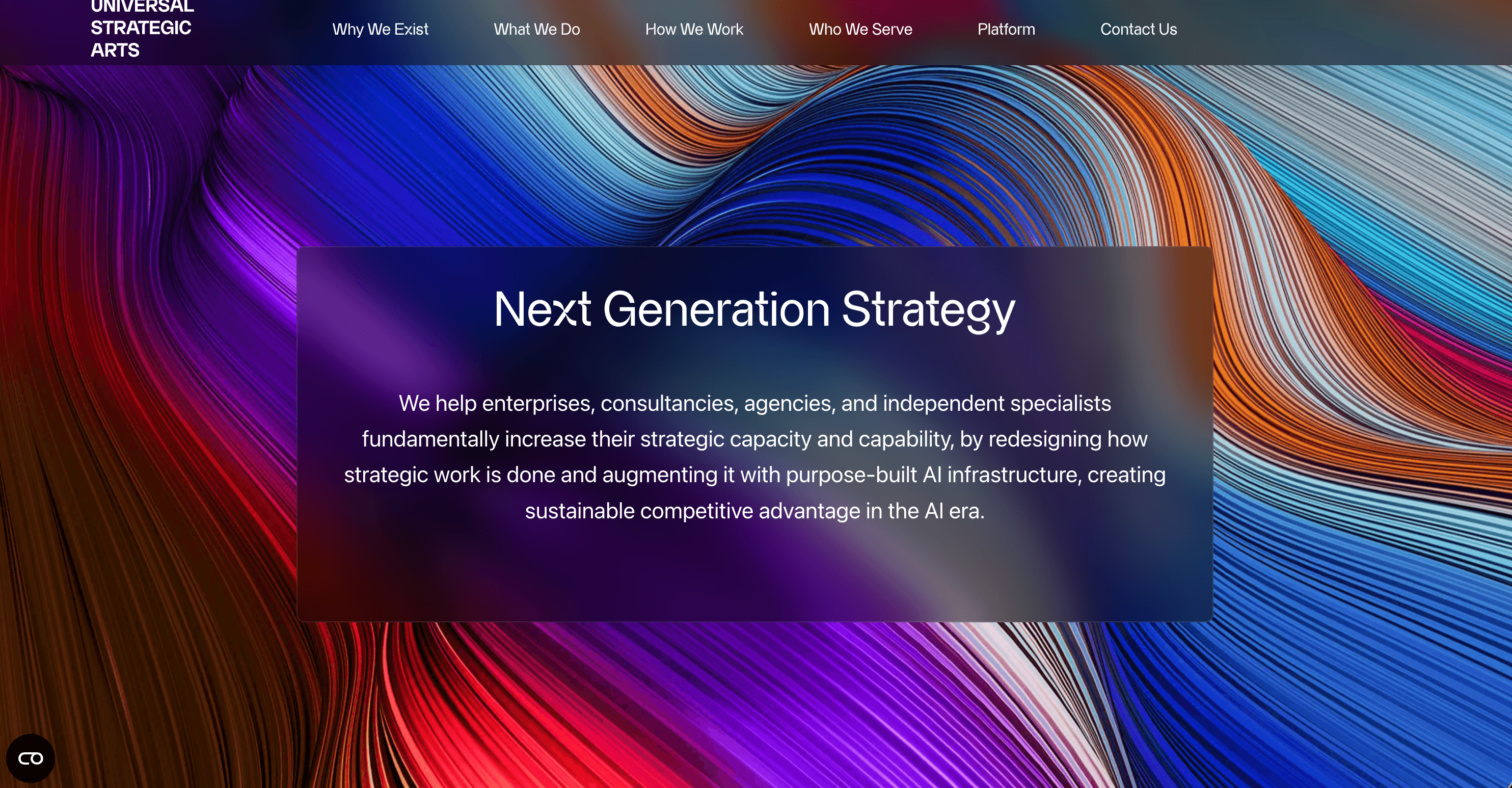
Universal Strategic Arts needed a front door that communicated the same ambition as the platform behind it. I designed and built thisisuniversal.com, the corporate site that positions the product for enterprises, consultancies, agencies, and independent specialists. “Next Generation Strategy” is the headline: AI infrastructure for strategic work, not another chatbot wrapper.
Design and engineering, same person.
- 01Designed the 19-hub navigation system
Colour-coded Hub Tab Bar with fixed positioning. Each hub has its own identity and agent tools. Navigating between hubs is instant.
- 02Built the Blueprint v3 component system
A structured component library powering every hub. Cards, dropdowns, filters, modals: all consistent, all documented.
- 03Designed the Card Creator
AI-powered content generation that uses contextual information from the current strategy. The agent tools panel adapts per hub.
- 04Built the enterprise data layer
GCP integration for client analytics: BigQuery for querying, Cloud Storage for assets, connected to the frontend via API routes.
- 05Led the Pinnlo → Unity rebrand
New identity, new colour system, new navigation. Migrated the full codebase while shipping features in parallel.
Enterprise is a different design problem.
Solo products let you move fast and break things. Enterprise products break other people's things. The 5 C's framework (Connect, Contextualize, Collaborate, Capability, Competitive Advantage) was the structure that kept 19 hubs coherent instead of chaotic.
White-labelling forced me to think in systems, not screens. Every colour, every component, every agent prompt had to work across different brands without hard-coded assumptions. That constraint made the design system sharper.
Scaling from solo to enterprise taught me that the hardest design work isn't pixels. It's deciding what 19 hubs share and where they diverge.